
 Clarity
 Visibility
 Connections
 Credibility
 Packages

 Next
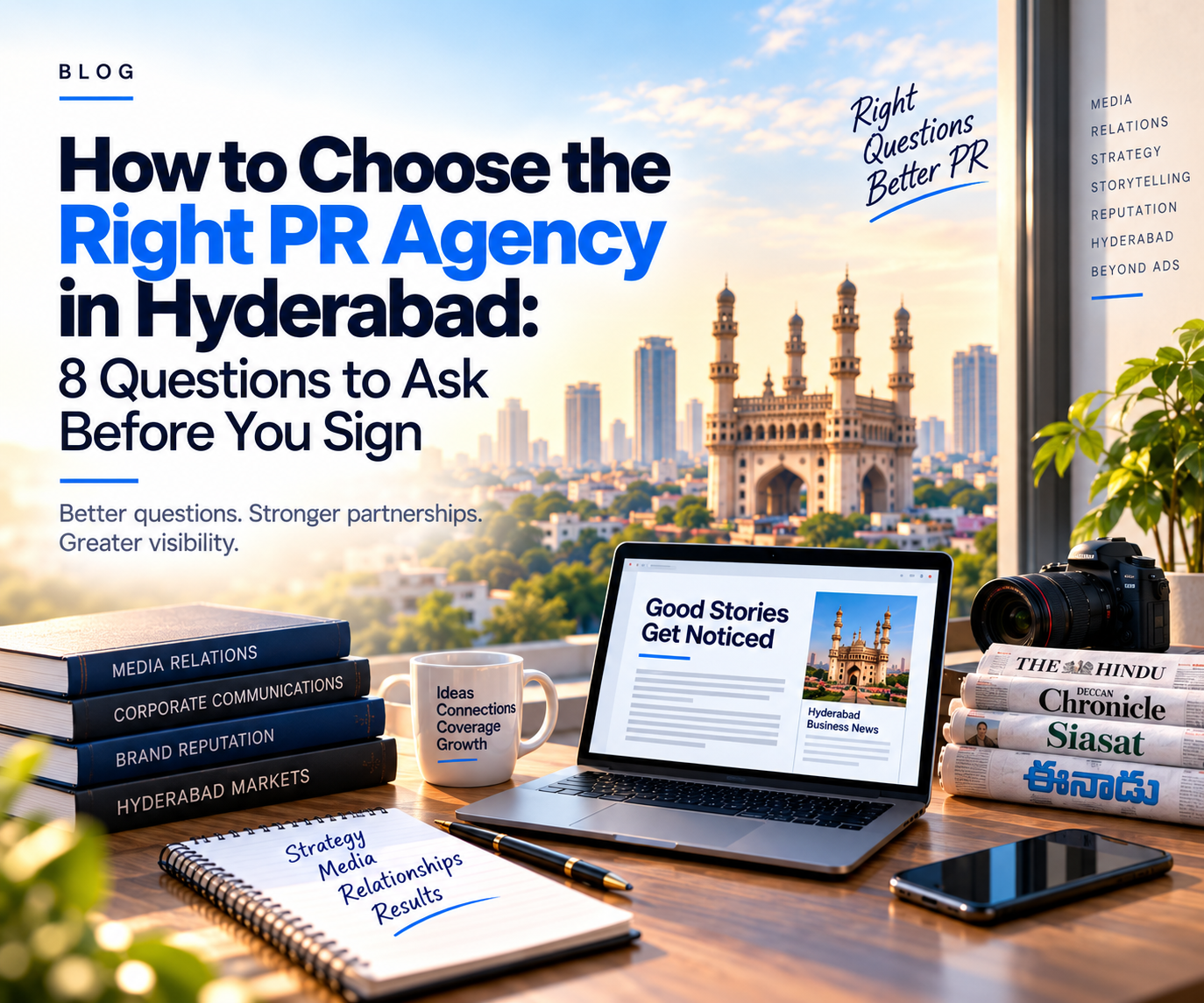
Choosing the right public relations (PR) agency requires more than comparing proposals, pricing, and promises. Unlike many other marketing services, PR depends heavily on relationships, editorial judgment, storytelling, and the ability to connect your brand with the right media outlets. These qualities can be difficult to evaluate before you sign a contract.
Many businesses looking for a PR agency in Hyderabad encounter agencies promising extensive media coverage, impressive reach, and instant brand visibility. However, not every agency offering PR services delivers the same value. Some focus on genuine media relations, while others primarily offer press release distribution or paid promotional placements.
Understanding this difference is essential when choosing a PR partner for your business.
Whether you are a startup founder, hospital administrator, real estate developer, educational institution, or established company, asking the right questions can help you make an informed decision.
At Manik Advertisers, we believe businesses should understand exactly what they are paying for before committing to a marketing or public relations partnership.
Here are eight important questions to ask before choosing your PR agency.
1. Can You Guarantee That My Story Will Be Published?
This is one of the most important questions to ask any PR agency.
A professional agency should explain that genuine editorial coverage cannot be guaranteed. Journalists and editors independently decide whether a story deserves publication based on its relevance, newsworthiness, timing, and audience interest.
A capable agency can improve your chances of gaining coverage through strategic storytelling, targeted media outreach, and well-developed journalist relationships. However, promising guaranteed editorial publication without explaining the conditions deserves closer scrutiny.
If an agency promises guaranteed publication, ask what that guarantee includes.
There is an important distinction between:
- Earned media coverage: Editorial coverage secured through newsworthiness and media relations.
- Paid media placements: Sponsored articles, advertorials, or other promotional placements purchased for a fee.
- Press release distribution: Sending announcements through distribution services to media outlets or subscriber networks.
Each approach can serve a purpose, but they offer different benefits and should be evaluated separately.
The Press Council of India has documented concerns surrounding paid news, including content presented as independent journalism despite being published for consideration in cash or kind.
Before signing a contract, clarify whether the proposed service focuses on earned media, paid placements, or distribution.
What to look for: An agency that explains its approach honestly, sets realistic expectations, and clearly distinguishes editorial coverage from paid promotion.
2. Which Journalists and Publications Will You Approach?
Almost every agency claims to have strong media contacts. The more important question is whether those contacts are relevant to your business and campaign.
For example, a hospital announcing a new treatment facility may benefit from outreach to healthcare journalists, city reporters, and relevant business publications. A real estate company launching a residential project may need connections with property journalists, business editors, and local news outlets.
An experienced PR agency in Hyderabad should be able to explain its media targeting strategy and identify the types of journalists, publications, and editorial desks most relevant to your story.
Ask questions such as:
- Which publications are most relevant to my target audience?
- Which journalists or editorial desks cover my industry?
- How will you identify the right angle for our announcement?
- How will you approach local, regional, and national media?
- What happens if the initial media outreach does not generate interest?
An agency may not be able to disclose every private contact or guarantee that a journalist will respond. Nevertheless, it should be able to explain its targeting process with specific, relevant examples.
What to look for: A clear media outreach strategy tailored to your business rather than a generic list of media contacts.
3. Do You Handle Media Relations Personally or Use a Distribution Service?
The term PR can describe several different services, and understanding the difference can help you evaluate agency proposals more accurately.
Genuine media relations involves developing relevant story angles, identifying suitable journalists, pitching stories individually, responding to media enquiries, and maintaining professional relationships with media representatives.
Press release distribution, on the other hand, involves circulating announcements through a distribution platform or media contact list.
Distribution services can be useful when your objective is to announce a product launch, company milestone, event, or business update. However, sending a press release does not automatically mean a journalist will read it, pursue the story, or publish an article.
Before hiring an agency, ask:
- Will your team write our press releases?
- Will you pitch stories directly to relevant journalists?
- Do you use third-party distribution platforms?
- Are distribution charges included in the proposal?
- How will you follow up after sending a press release?
These questions are particularly useful when comparing an integrated PR agency with a provider offering only press release distribution.
An integrated agency may combine media relations with content development, digital marketing, brand communication, and other promotional services. This broader approach can help businesses maintain consistent messaging across different channels.
What to look for: A transparent explanation of the services included in your package, the role of third-party providers, and the expected deliverables.
4. How Will You Measure the Success of My PR Campaign?
PR success should be evaluated using meaningful performance indicators rather than impressive-sounding numbers alone.
An agency might report potential audience reach, impressions, or general brand visibility. While these metrics can provide context, they do not necessarily demonstrate that your campaign generated valuable media coverage or improved brand awareness.
Ask your prospective agency how it measures and reports campaign performance.
Useful PR performance indicators may include:
- Number of relevant media mentions secured.
- Quality and relevance of publications covering your business.
- Accuracy of brand messaging in published stories.
- Share of voice compared with selected competitors.
- Referral traffic generated by online media coverage.
- Changes in branded search activity or website engagement.
- Quality of backlinks earned from relevant publications, where applicable.
For a digital PR agency, online visibility and the quality of digital media coverage may be particularly important.
Digital PR can support SEO by earning relevant editorial mentions and links, improving brand discoverability, and creating content that attracts attention across online channels. However, rankings and backlinks should never be treated as guaranteed outcomes.
Your agency should also provide regular reports explaining what was achieved, which activities contributed to the results, and what should happen next.
What to look for: Clear reporting, verifiable coverage, relevant performance indicators, and realistic expectations.
5. How Will You Handle Difficult Media Questions or Unexpected Situations?
Public relations is not limited to positive announcements and promotional stories. Businesses may also face challenging questions, negative publicity, customer complaints, or unexpected developments.
A reliable agency should be prepared to help you respond professionally when a story does not develop as expected.
For example, a healthcare organisation may receive questions about patient safety, a real estate developer may face questions about project delays, or a company may need to address a public complaint.
Your PR partner should understand how to prepare spokespersons, develop consistent messaging, verify facts, and respond appropriately to media enquiries.
Ask the agency:
- Do you provide media interview preparation?
- Can you help develop key messages and spokesperson guidelines?
- How do you manage sensitive or potentially damaging stories?
- Who will coordinate responses to urgent media enquiries?
- Do you offer crisis communication support, and is it included in the package?
These questions can help you understand whether the agency offers ongoing strategic support or focuses primarily on distributing announcements.
A strong PR partner should also advise you when a particular response may create additional reputational risks.
What to look for: A clear communication process, thoughtful preparation, and an understanding of reputational risk.
6. How Will You Disclose Paid or Sponsored Content?
Transparency is essential when PR campaigns involve paid promotional placements.
Businesses sometimes purchase sponsored articles, advertorials, influencer collaborations, or other promotional content. These activities can be useful, provided the commercial nature of the content is appropriately disclosed.
The Advertising Standards Council of India’s advertising code addresses the need for advertising to be identifiable as advertising. Applicable disclosure requirements may vary depending on the format, platform, and nature of the placement.
Ask your prospective agency:
- Does the proposal include paid media placements?
- Will sponsored content be clearly identified?
- Are publication fees separate from agency fees?
- Will we receive a breakdown of third-party charges?
- How will paid promotional content differ from earned editorial coverage?
This distinction matters because audiences may view independently produced journalism differently from paid brand promotion.
An agency should never leave you uncertain about whether a proposed publication opportunity is editorial coverage or a paid placement.
For businesses investing in an integrated PR agency, transparency is equally important across PR, advertising, influencer marketing, and digital promotional activities.
What to look for: Clear pricing, appropriate disclosures, written deliverables, and an honest explanation of the nature of each placement.
7. Can You Share Relevant Experience in My Industry?
Every industry has different audiences, communication requirements, and media opportunities.
A hospital needs to communicate healthcare information responsibly. A real estate company may focus on project announcements, market developments, and business milestones. An educational institution may need coverage related to admissions, academic achievements, or institutional initiatives.
This is why industry experience matters when choosing a PR partner.
Ask the agency whether it has worked with businesses similar to yours and whether it can share relevant examples of previous campaigns.
Useful questions include:
- Have you handled PR campaigns in our industry?
- Can you share examples of relevant media coverage?
- What challenges did you encounter during similar campaigns?
- How did you adapt the messaging to the target audience?
- Can we speak with a client who has similar communication needs?
An agency may not have worked with a business identical to yours. That does not automatically make it unsuitable. Strong research skills, relevant media relationships, and a thoughtful communication strategy can also be valuable.
The important thing is to understand how the agency plans to approach your specific requirements.
What to look for: Relevant case studies, credible examples, an understanding of your audience, and a strategy tailored to your sector.
8. Who Will Manage My Account on a Day-to-Day Basis?
The person presenting your proposal may not be the person handling your campaign after the contract is signed.
This is common across the marketing industry. Senior professionals may lead strategy and client acquisition, while account managers and other team members handle daily execution.
That arrangement can work well, provided roles and responsibilities are clearly communicated.
Before signing, ask:
- Who will be our primary point of contact?
- Who will develop the PR strategy and approve key messaging?
- How often will we receive campaign updates?
- How will urgent requests be handled?
- Will senior team members be available when strategic decisions are needed?
- Who will be responsible for reporting and campaign reviews?
Understanding the team’s structure helps you establish realistic expectations around communication, turnaround times, and accountability.
It also allows you to determine whether the proposed service level matches your budget.
What to look for: A clearly defined team, accessible communication channels, agreed reporting schedules, and transparent responsibilities.
What Do the Best PR Agencies Have in Common?
The eight questions above are not intended to catch agencies making mistakes. They are designed to help you understand what you are buying and whether the agency can deliver the service your business actually needs.
A dependable PR partner should be able to explain its strategy, identify relevant media opportunities, distinguish earned coverage from paid promotion, and establish realistic performance expectations.
When evaluating a potential agency, prioritise the following:
- Transparency: Clear pricing, deliverables, and expectations.
- Media strategy: Relevant publications, journalists, and story angles.
- Industry understanding: Knowledge of your audience and business objectives.
- Measurable outcomes: Meaningful reporting and verifiable coverage.
- Communication: Clearly defined roles and regular updates.
- Ethical practices: Appropriate disclosure of sponsored content and honest reporting.
- Long-term thinking: A strategy that supports brand reputation beyond individual announcements.
Businesses should also consider whether they need standalone PR services or a broader marketing partner.
A specialised PR firm may be suitable when media relations is the primary objective. An integrated PR agency may be a better fit when a business wants coordinated brand communication across public relations, advertising, content marketing, and digital channels.
Similarly, a digital PR agency may be appropriate for businesses looking to strengthen their online reputation, secure relevant digital media coverage, and support broader search visibility goals.
If your requirements extend beyond public relations to paid campaigns, creative development, and brand promotion, comparing a full-service advertising agency in Hyderabad may also be worthwhile.
The right choice ultimately depends on your business objectives, target audience, budget, and the services you need.
Looking for a PR and Advertising Partner in Hyderabad?
Choosing the right agency is an important decision for any business investing in brand visibility and reputation.
At Manik Advertisers, we believe the best partnerships begin with clear communication, realistic expectations, and an understanding of the client’s goals. Before committing to any PR or advertising proposal, take the time to evaluate the strategy, deliverables, reporting process, and experience behind it.
Whether you are exploring PR opportunities, planning a brand announcement, or comparing marketing proposals, asking the right questions can help you make a more confident decision.
If you are looking for a PR agency in Hyderabad or an advertising agency in Hyderabad, contact Manik Advertisers to discuss your business requirements and explore suitable communication and promotional strategies.
Have a PR proposal you are considering? Contact Manik Advertisers through WhatsApp or your preferred communication channel to discuss your requirements and determine which services best match your business goals.