
 Clarity
 Visibility
 Connections
 Credibility
 Packages

 Next
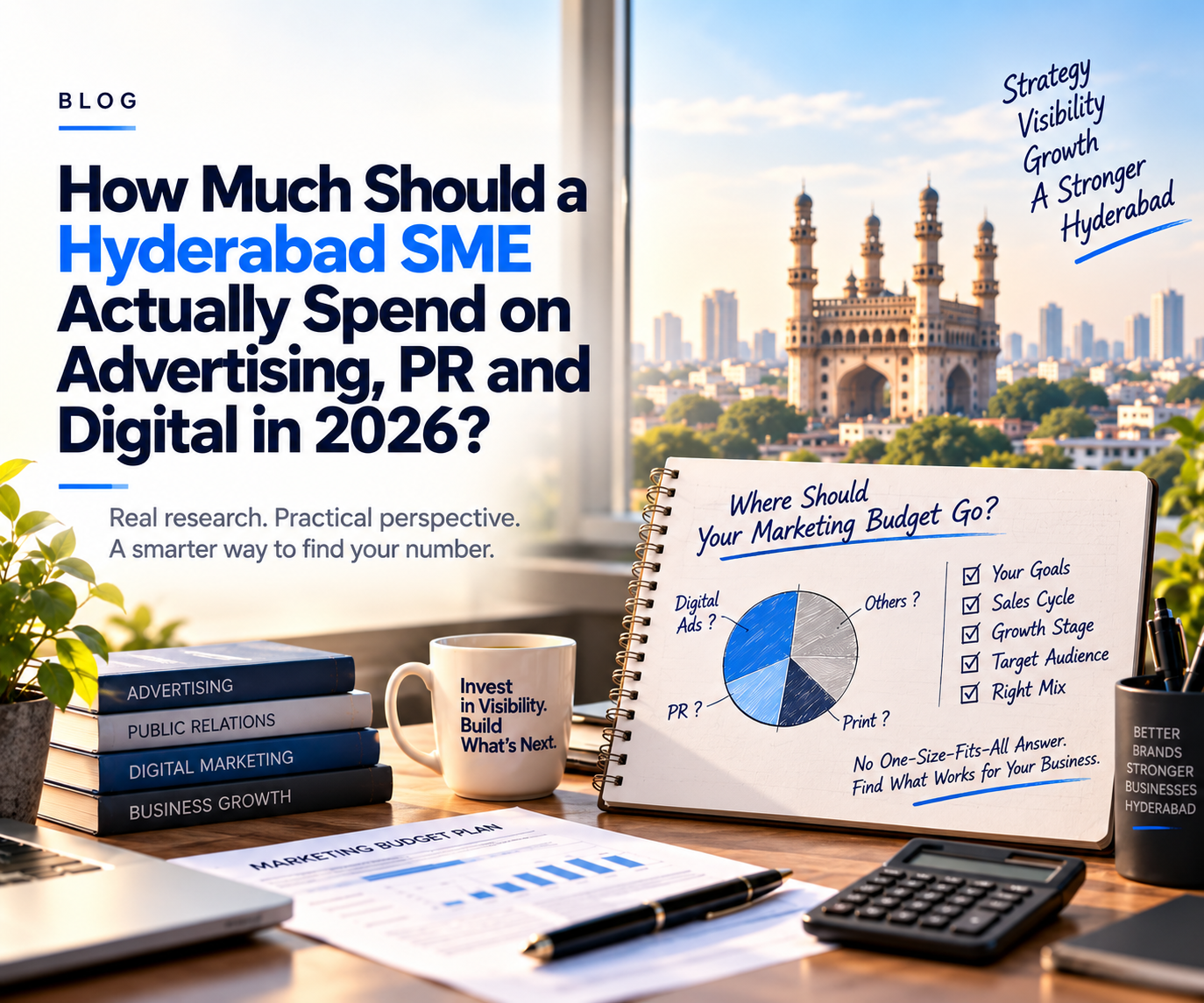
Search this question and you’ll find a dozen articles giving you a single, confident percentage of revenue to spend on marketing. Almost none of them tell you where that number came from. Usually it’s because it didn’t come from anywhere in particular; it’s a figure an agency has repeated often enough that it now sounds like research.
So before giving you a number, it’s worth being honest about what’s actually been measured, because that changes how much weight you should put on any answer, including this one.
What We Actually Know, and Who It’s Actually About
Gartner runs the closest thing to a rigorous, repeated survey on this question, the CMO Spend Survey, now in its latest 2026 edition with 401 CMOs and marketing leaders responding between January and March. The finding: marketing budgets sit at 7.8% of company revenue in 2026, up marginally from 7.7% in 2025, after a run of tighter years before that.
Here’s the part that matters for a Hyderabad SME reading this: the vast majority of Gartner’s respondents run companies with revenue over $1 billion, based in North America, the UK, and Europe. This is genuinely useful data. It’s just not data about you. A hospital doing a few crore in annual revenue in Banjara Hills and a multinational doing a billion dollars in New Jersey are not solving the same budgeting problem, even if they’re both technically “spending on marketing.”
For Hyderabad businesses looking to improve their market presence, working with an experienced advertising agency in Hyderabad can help determine how much to allocate across advertising, PR and digital marketing based on actual business goals rather than generic industry benchmarks.
No Equivalent Study Exists for Indian SMEs, and It’s Worth Saying That Plainly
We looked. What exists instead is a set of ranges that individual agencies and consultants repeat based on client experience, not a published, methodologically sound survey. That’s not a knock on the number; it just means you should treat it as informed judgment, not measured fact, and weight it accordingly.
With that caveat stated clearly: the range most experienced marketers and financial advisors converge on, across dozens of informal sources rather than one authoritative one, runs roughly like this.
Businesses in a steady, established phase, where the goal is holding position rather than growing share, tend to spend somewhere around 3-5% of revenue. Businesses actively trying to grow, win new categories of customer, or catch up to a better-known competitor tend to sit closer to 7-10%. A genuine launch, or a business trying to take meaningful share from an entrenched incumbent fast, often runs 12% or higher, deliberately, for a defined period, not indefinitely.
What Should Actually Decide Where You Land in That Range
The percentage matters less than the reasoning behind it, so here’s what to actually weigh.
Are you defending or attacking? If most of your business already comes in through repeat clients and referrals, you need less spend to maintain visibility than a business trying to break into a new customer segment from a standing start.
How long is your sales cycle? A retail business closes a customer in one visit. A hospital, a real estate developer, or a B2B services firm might be working a six-to-eighteen-month consideration window with the same prospect. Longer cycles need sustained visibility and credibility-building spread over that whole window, not a burst of activity followed by silence, because the prospect who sees you once and doesn’t convert immediately needs to still recognise you eight months later.
This is where a PR agency in Hyderabad can add value by building brand credibility through media coverage, strategic communication and consistent public visibility. Businesses can also explore digital PR services to strengthen their online reputation, improve brand awareness and build trust among potential customers throughout the decision-making process.
How much of your growth is coming from outside your existing network? If your pipeline is mostly warm introductions, your spend is really about reinforcing a reputation people already partially trust. If you need cold discovery, first-time strangers finding you and deciding you’re credible with zero prior context, that’s a harder and more expensive job, and your budget should reflect that.
How to Split It, Once You Know the Total
This is where the FICCI-EY Media & Entertainment Report 2026 is genuinely useful, not as a prescription for your specific split, but as context for what’s actually happening at a national level. Digital advertising grew 26% in 2025 to reach roughly 63% of all Indian advertising spend, while print grew a modest 2%. That national shift is real, and it explains why almost every generic marketing budget guide now leans hard toward digital by default.
But that national average is dominated by categories built for high-frequency digital targeting: e-commerce, consumer apps, fast-moving retail. It says less about a hospital, a real estate developer, or a B2B services firm, where the decision is infrequent, expensive, and trust-dependent, and where the FICCI-EY report itself notes that print and earned media are still holding ground specifically in auto, real estate, BFSI, and retail because they reach the affluent, high-consideration buyer these categories actually sell to.
For businesses looking for an integrated approach, a digital marketing advertising agency can help coordinate paid campaigns, SEO, social media, content marketing and online reputation management under one strategy. Choosing among the best ad agencies in Hyderabad should therefore involve looking beyond campaign execution and evaluating their ability to connect marketing activities with measurable business outcomes.
The practical version: let your sales cycle length set the PR-to-paid ratio, not a national average built for a completely different kind of purchase. A long, expensive, trust-dependent sale needs a heavier weighting toward credibility-building, earned coverage and founder visibility. A short, low-consideration purchase can lean harder into paid digital reach, because the buyer doesn’t need to trust you deeply before converting once.
The Honest Answer
There isn’t a single correct percentage, and anyone giving you one without asking a single question about your business first is guessing on your behalf, not doing math. What you actually need is your own number, built from your real sales cycle, your real mix of warm versus cold demand, and how much of your growth depends on strangers trusting you before they’ve met you.
If you want help working out that number for your specific business rather than borrowing someone else’s, that’s exactly what a proper discovery conversation is for. Reach us on WhatsApp or drop us a line.