
 Clarity
 Visibility
 Connections
 Credibility
 Packages

 Next
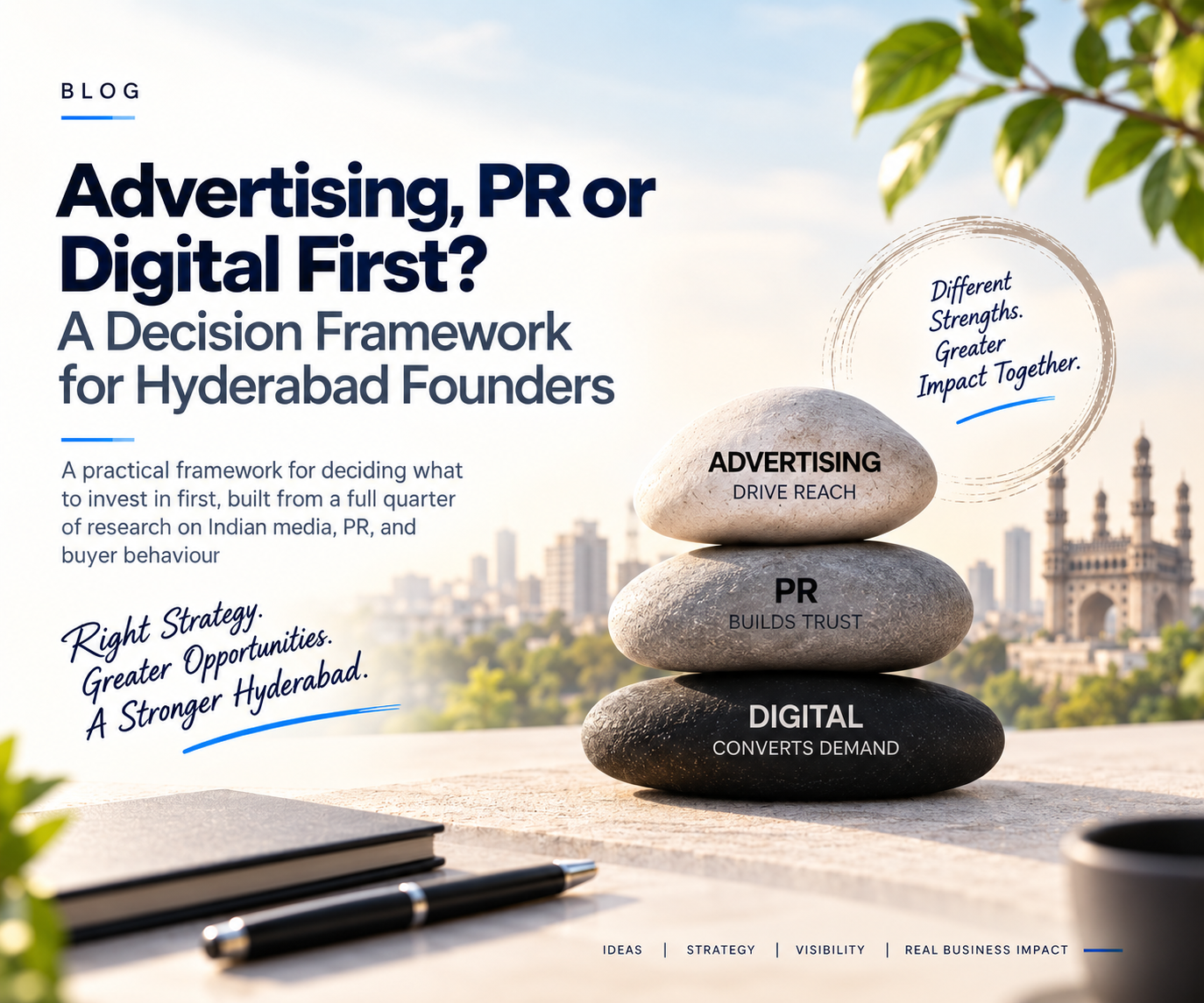
Over the past few months, this series has covered a lot of ground: why print still carries trust that digital hasn’t replicated, how to sequence PR so it compounds, what actually gets you noticed by a Hyderabad newsdesk, what to check before hiring anyone to do any of this, why founders who get written about outperform founders who only get advertised, what the research actually says about marketing budgets, why hospitals with excellent clinical work still lose patients to hospitals with better visibility, and why most marketing problems are actually GTM problems wearing a content problem’s clothes.
Put together, that’s not eight separate ideas. It’s one answer to one question, approached from eight angles: where should your next rupee actually go. Here’s that answer, as a usable framework instead of eight separate essays.
Step zero: is your GTM question actually settled?
Before advertising, PR, or digital enters the conversation at all, check the thing this series covered in December: can you name your specific buyer precisely, and can you say in one sentence why they should pick you over the obvious alternative? If the honest answer is no, nothing below matters yet. CB Insights’ analysis of failed venture-backed companies found poor product-market fit behind 43% of failures, dwarfing every cause except running out of money outright, and running out of money is usually what that underlying problem looks like once it’s had enough time to bite. Fix this first. Every channel below performs worse, sometimes dramatically worse, when it’s amplifying an unclear answer.
Step one: how long and how trust-dependent is your actual sale?
This is the single biggest fork in the road, and it was the core finding of the November budget piece. A short, low-consideration purchase, retail, a quick service booking, doesn’t need the buyer to deeply trust you before they’ll try you once. A long, expensive, high-consideration sale, a hospital admission, a property purchase, an education decision, a BFSI-adjacent commitment, absolutely does. The FICCI-EY Media & Entertainment Report 2026 found print and earned media specifically holding their ground in exactly these high-consideration categories, auto, real estate, BFSI, retail, because those are the categories where a stranger needs convincing before they’ll commit real money.
If your sale is short and low-consideration: digital-first is defensible. Speed and targeted reach do most of the necessary work.
If your sale is long and high-consideration: PR and credibility-building need to lead, with digital layered in for reach once trust exists, not instead of it. Working with an experienced PR agency in Hyderabad can help businesses build credibility through strategic media coverage, founder visibility and consistent brand communication. Businesses can also leverage digital PR services to strengthen online reputation and make their brand presence more discoverable across digital platforms.
Step two: are you defending a reputation or building one from zero?
If you already have a base of referrals and repeat business, you’re reinforcing existing trust, and a lighter, more digital-leaning mix usually suffices, per the same November analysis. If you’re a new hospital, a first-time developer, or a founder nobody’s heard of yet, you’re building trust from nothing, and that’s a fundamentally different, heavier task. The October piece on founder visibility is the sharpest illustration of this: Weber Shandwick’s research found executives attributing 63% of a company’s market value to reputation broadly, and 44-45% specifically to CEO reputation. If you’re starting from zero, a meaningful share of what you’re actually building is personal, not just institutional, credibility.
Step three: where does your specific buyer actually look, and in what language?
The September piece on Hyderabad’s media landscape matters here more than almost anything else in this series, because “digital vs. print” is the wrong question if you haven’t first answered “which Hyderabad.” Telugu-language readers, English-language HITEC City professionals, and Old City retail audiences are effectively three different markets that happen to share a city boundary. Whatever channel wins Step One and Step Two still has to be pointed at the actual language and geography your buyer occupies, or none of the rest of this framework matters.
An experienced advertising agency in Hyderabad can help businesses identify the right mix of local advertising, digital campaigns and PR activities based on their target audience, market positioning and growth objectives.
Step four: build the ladder, don’t buy one placement
Once you know the sale type, the trust position, and the audience, the September piece on integrated PR strategy laid out the sequence that actually compounds: local proof first, then online pickup that makes you findable, then top-tier features that carry real editorial weight. This applies whether the underlying channel is mostly PR-led or mostly digital-led. A single placement, in any channel, rarely does what a sequence does.
When evaluating the best ad agencies in Hyderabad, founders should look for agencies that understand this integrated approach rather than focusing on isolated campaigns. The right partner should be able to connect advertising, PR, digital visibility and reputation-building into one consistent growth strategy.
A worked example, because the framework means more with a case attached
Take the November piece on hospital marketing. FICCI-EY-Parthenon’s research found 83% of patients actively researching before a healthcare decision, but only about a third able to easily find good information, so most fall back on reputation (60%) and word-of-mouth (79%) instead. Run that hospital through the framework: the sale is long and high-consideration (Step One says PR-led), a new or lesser-known hospital is building trust from zero (Step Two says heavy investment, including founder visibility), the buyer is searching in a specific language and neighbourhood (Step Three says know exactly who and where), and the fix is a sustained ladder of local coverage building to national credibility, not a single press release (Step Four). Every piece of this series’ research points at the same conclusion for that specific business, because they were never really eight separate answers to begin with.
Where this leaves you
If you’ve read this whole series, you already have more of the diagnostic done than most businesses that walk into an agency conversation. The honest next step, for most Hyderabad founders, isn’t picking a channel off this list in isolation. It’s running your own business through these four steps and seeing which combination the answers actually point to, which is precisely what a real discovery conversation is for, rather than a templated proposal.
If you want to work through this framework for your specific business rather than apply it in the abstract, we’re happy to talk it through. Reach us on WhatsApp or drop us a line.