
 Clarity
 Visibility
 Connections
 Credibility
 Packages

 Next
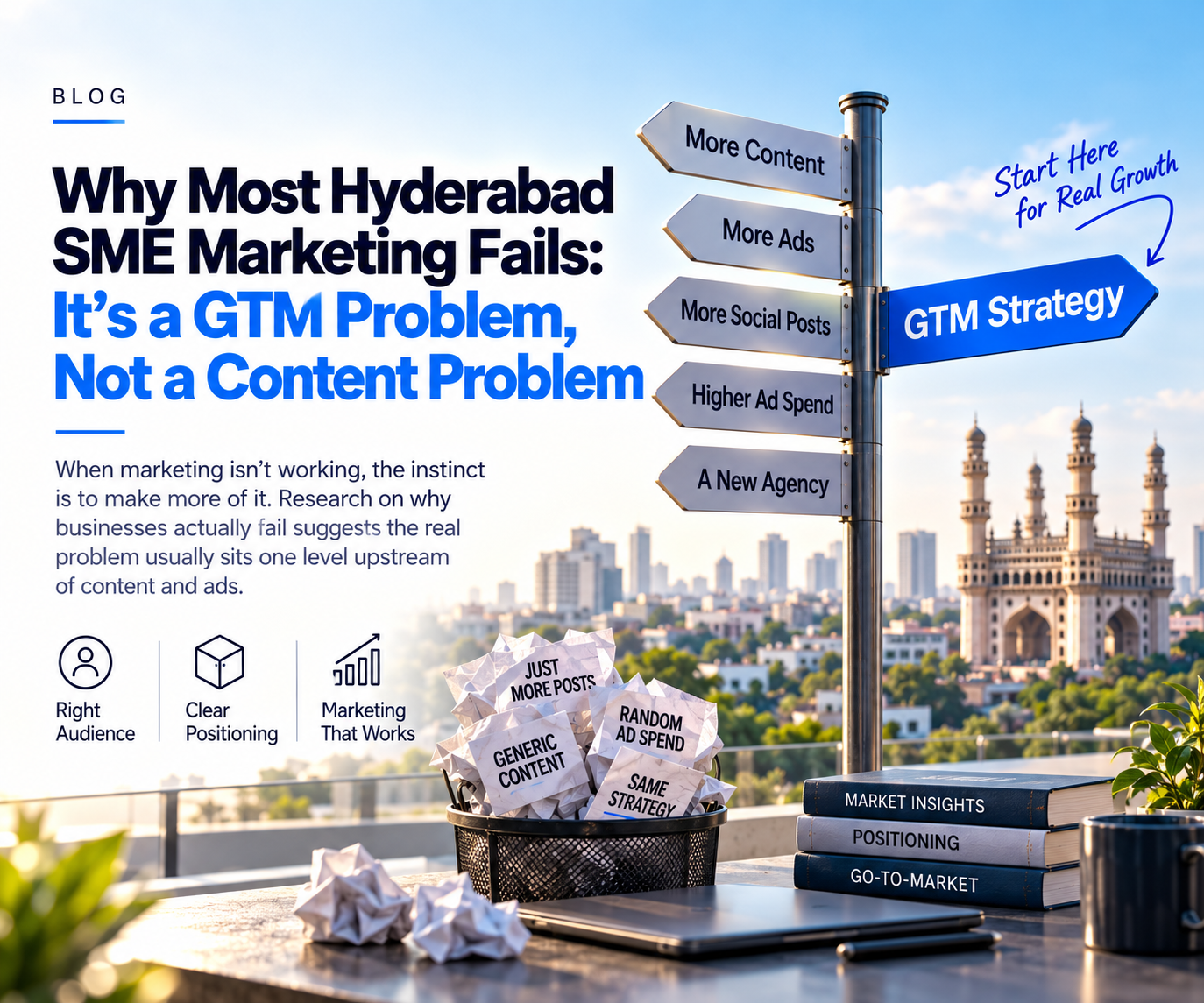
A Hyderabad business owner spends six months posting more, boosting more, running more ads, and the enquiries barely move. The conclusion almost everyone reaches from here is the same: we need better content, or a better agency to make it. That conclusion is usually wrong, and it’s worth understanding why before spending another rupee chasing it.
The evidence points somewhere else entirely
CB Insights, which has spent years analyzing why venture-backed companies shut down, looked at 431 companies that failed since 2023 and found identifiable reasons for 385 of them. Running out of capital was the most commonly cited cause, at 70%, but the report itself makes an important distinction: running out of money is usually the final event, not the actual cause. The deeper reason showing up underneath it, in 43% of cases, was poor product-market fit, the company built something, aimed it at a market, and the market didn’t want it enough to sustain the business. That dwarfs every other identified cause except capital itself.
These are venture-backed startups, not Hyderabad SMEs, and that difference matters, so take the specific percentage as illustrative rather than a direct prediction for your business. But the underlying mechanism generalizes cleanly: when what you’re offering, and who you’re offering it to, and why they should pick you over the obvious alternative aren’t clearly worked out, no amount of downstream marketing activity fixes that. It just spends money finding out the hard way, faster.
“We need more content” is almost always the symptom, not the diagnosis
Here’s the pattern we see constantly. A business isn’t getting enquiries. The instinct is to increase volume: more posts, more ad spend, a content calendar with more entries on it. That’s treating the visible symptom. The actual question almost nobody asks first is upstream of any of that: does this business know, specifically, who it’s for, and can it say in one sentence why that specific person should choose it over the next obvious option?
If the honest answer is “we’re for anyone who needs [category],” that’s not a target market, that’s the absence of one, and it’s why the content built on top of it feels like it’s shouting into a room with nobody in particular listening. More content aimed at nobody in particular is still aimed at nobody in particular. It just costs more.
For businesses looking to improve their marketing outcomes, partnering with an experienced advertising agency in Hyderabad can help establish a clear target audience, positioning strategy and marketing direction before investing heavily in content creation and paid campaigns.
What a GTM problem actually looks like in practice
It rarely announces itself as “we have a positioning problem.” It shows up as a string of smaller symptoms that get treated individually instead of traced back to their source. Enquiries that come in but don’t convert, because the person who clicked wasn’t actually the buyer the offer was built for. A sales team that gives a different answer every time someone asks “what do you do differently,” because there was never one agreed answer to begin with. Content that gets engagement but not enquiries, because it’s reaching people who find it interesting without being the people who’d ever actually buy.
Each of those gets diagnosed and treated separately, usually with more of whatever wasn’t working. The pattern only becomes visible once you stop asking “how do we make this content perform better” and start asking “is this content aimed at a clearly defined person with a clearly defined reason to choose us.”
Three questions that surface it faster than any content audit
Can you describe your ideal customer specifically enough that a stranger could recognize them walking into a room, not “SME owners in Hyderabad” but the actual role, situation, and problem they have right now. Do you know, with real specifics, why the last five prospects who didn’t buy from you went elsewhere, or is that a guess dressed up as an answer. And does your current marketing activity match where that specific buyer actually looks for information, or does it match where marketing is easiest to produce, which are frequently not the same channel at all.
Founders who can answer all three clearly usually do have a content or execution problem, and more or better content genuinely helps them. Founders who can’t are, more often than not, funding content production to paper over a question that was never actually settled.
When evaluating the best ad agencies in Hyderabad, businesses should look beyond creative execution and social media posting. The right marketing partner should understand the company’s positioning, target audience, customer journey and overall go-to-market strategy. Similarly, established advertising companies in Hyderabad and professional ad makers in Hyderabad should be evaluated on their ability to connect creative campaigns with actual business objectives rather than simply increasing content volume.
Why this connects to everything else in this series
Every post in this series so far has made some version of the same underlying point: credibility and trust have to be built deliberately, aimed at a specific audience, through channels that specific audience actually trusts. None of that works if the “specific audience” part was never nailed down. A brilliantly placed magazine profile aimed at the wrong reader is still aimed at the wrong reader. Getting the GTM question right first is what makes every tactic that follows, PR, content, media buying, actually compound instead of just accumulate.
If you suspect your marketing problem is actually further upstream than your content, that’s exactly what a proper GTM diagnostic is for. Reach us on WhatsApp or drop us a line.