
 Clarity
 Visibility
 Connections
 Credibility
 Packages
 Next
Next
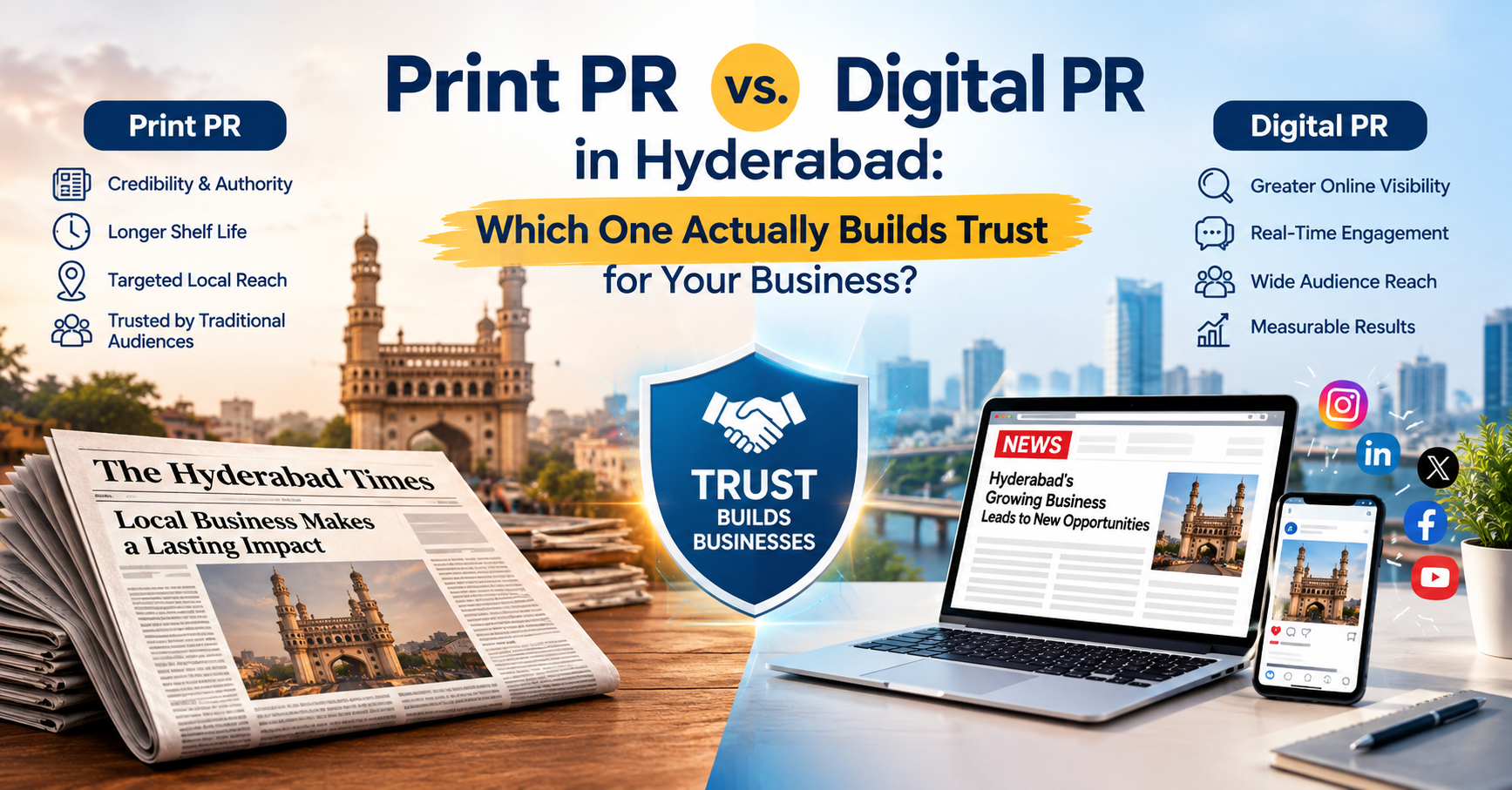
A hospital founder in Banjara Hills spends four lakhs a quarter on Instagram and Google ads. The enquiries come in fine. But when he sits across from a prospective investor, or a senior doctor he’s trying to recruit, he still gets asked, “Have I heard of you before?”
A few months later, one article about his hospital runs in a Hyderabad daily. His ad budget doesn’t change. But at a medical conference, or a family function, someone says, “Oh, you’re the one from the paper.” Same founder, same hospital. What changed is that one placement made him sound like someone worth trusting. The ad spend never managed that. It made him look like someone worth clicking on, which is a different thing entirely.
That gap, between reach and trust, is what this piece is about.
We’re not arguing print beats digital
Print and digital PR aren’t really competing for the same job, and it’s worth saying that plainly before going any further. Digital is built for speed, targeting and volume. Print does something else. It supplies the kind of third-party, independent-seeming endorsement that makes a stranger decide you’re legitimate before they’ve spoken to you.
Treat this as a fight where one format has to lose, and you end up with what most Hyderabad businesses have: a pile of impressions with no credibility, or a framed newspaper cutting with no leads. What matters isn’t which format you pick. It’s matching the job to the tool built for it.
What the 2025-26 numbers actually show
According to the FICCI-EY Media & Entertainment Report 2026, covering 2025 performance, India’s overall M&E sector grew 9% to reach ₹2.78 lakh crore. Digital advertising was the story of the year, up 26% to ₹94,700 crore, now roughly 63% of all advertising spend, and pushing total digital media revenue past ₹1 lakh crore for the first time.
Print, by comparison, grew a modest 2% in advertising revenue in 2025 even as circulation revenue slipped 1%. The report projects print growing at roughly 1% a year through 2028. On growth rate alone, digital has this comprehensively won. There’s no honest way to argue otherwise.
But growth rate isn’t the same question as trust, and the same report draws that line itself. Jayant Mammen Mathew of the Malayala Manorama Group said newspapers “will have a huge impact for brands, reinforcing credibility as they have adapted to changing consumption habits.” Sanjay Gupta of Jagran Prakashan called print’s future “a high-reach, high-impact credibility platform where trust, depth, and precision converge to drive reader engagement.” Neither man runs a PR agency with something to sell you. They run India’s largest print businesses, and even they aren’t claiming print wins on scale. They’re claiming it wins on trust, specifically in auto, real estate, BFSI and retail, categories the report says print is holding because it still reaches affluent metro and non-metro readers making high-consideration decisions.
Read that list again. Real estate. High-value retail. Anything BFSI-adjacent. A large share of Hyderabad’s SME and mid-market economy sits in exactly those categories, and that’s not a coincidence. It’s print doing the one job a feed full of ads still can’t: making a stranger believe you before they’ve met you.
Trust in specific mastheads is measured, and it moves
Which publication is trusted isn’t a matter of opinion in India. It’s tracked every year. TRA’s Brand Trust Report, now in its 15th edition, evaluates thousands of brands including media houses, and its 2026 edition recorded something that hadn’t happened since 2016: Hindustan Times overtook The Times of India in the trust rankings, at rank 628 against 980 all-India, with The Hindu at 915 and India Today at 996.
The exact ranks matter less than what they prove. Reader trust in a specific masthead isn’t fixed. It’s studied, and it shifts year on year, which means where you place a story, not just whether you get one, has a measurable effect on how much of that trust rubs off on you.
Hyderabad has its own version of this map
Hyderabad’s print readership isn’t one audience, it’s several running in parallel. Eenadu carries the largest Telugu readership in the city, and by most trade estimates, Telugu papers outsell English ones roughly four to one here. That matters a great deal if your customer is a Kukatpally family or a Secunderabad government employee rather than a HITEC City techie. Deccan Chronicle and Times of India lead the English segment and skew toward HITEC City, Gachibowli and Banjara Hills: IT professionals, corporate decision-makers, premium-lifestyle readers. Siasat holds the Old City almost entirely, reaching a retail and jewellery-trade audience neither English paper touches.
(Worth flagging: these readership patterns come from trade sources, not an ABC audit, and they shift. Cross-check them against current rate cards before committing a budget. Any agency worth using should hand you current numbers, not city folklore.)
The point isn’t “buy print” as some abstract rule. It’s that the masthead you choose is also a decision about which Hyderabad you’re trying to be trusted by.
What digital still does better
None of this argues for abandoning digital. A digital PR placement can go live in hours instead of weeks, which is a real advantage when timing matters. It keeps working long after a newspaper’s been recycled, since it surfaces every time someone Googles your name. And it lets you put a story in front of exactly the audience segment you want, at a fraction of what a print insertion costs to reach the same number of eyeballs.
If this quarter’s goal is enquiries, footfall, or measurable leads on a deadline, digital is usually the faster lever, and there’s no shame in reaching for it. Where founders get into trouble is expecting that reach to quietly turn into the kind of trust a stranger extends before you’ve said a word. Digital wasn’t built to do that job, so it’s a bit unfair to blame it when it doesn’t.
A simple test before you spend your next PR rupee
Would you frame it and put it on your office wall? Would you forward it to an investor, a bank, or a board member without any explanation attached? A well-placed print feature or a top-tier digital one, a business magazine profile, a respected news site’s coverage, a podcast with real editorial standing, tends to pass that test. A paid social post, however well it performed, usually doesn’t. That’s not a knock on the ad. It simply isn’t what the ad is for.
So which one should you actually use?
Both, but not randomly, and not at the same stage of your growth. Digital does the work of speed and reach. Print and top-tier earned media do the work of trust, and that matters most if you’re in real estate, healthcare, education, or BFSI-adjacent business, where a stranger has to believe you before they’ll write a cheque or sign a contract. In our own conversations with hospital founders, real estate developers and CXOs across Hyderabad, that trust question is almost always what’s actually being debated in the boardroom. The platform a story ran on rarely comes up.
Sequencing the two well, so each piece of coverage makes the next one land harder, matters more than picking a favourite. That’s the part we’ll walk through next: what that sequence looks like in practice for a Hyderabad business trying to build credibility that survives a boardroom, not just a scroll.
If you’re weighing where your next PR rupee should go, we’re happy to talk it through. Reach us on WhatsApp or drop us a line.